

“Having volunteered with the Red Cross in my hometown, Tripoli, I witnessed a multitude of the worst effects of the state’s injustice inflicted on the most vulnerable people. I think these injustices are what push me to resist.”
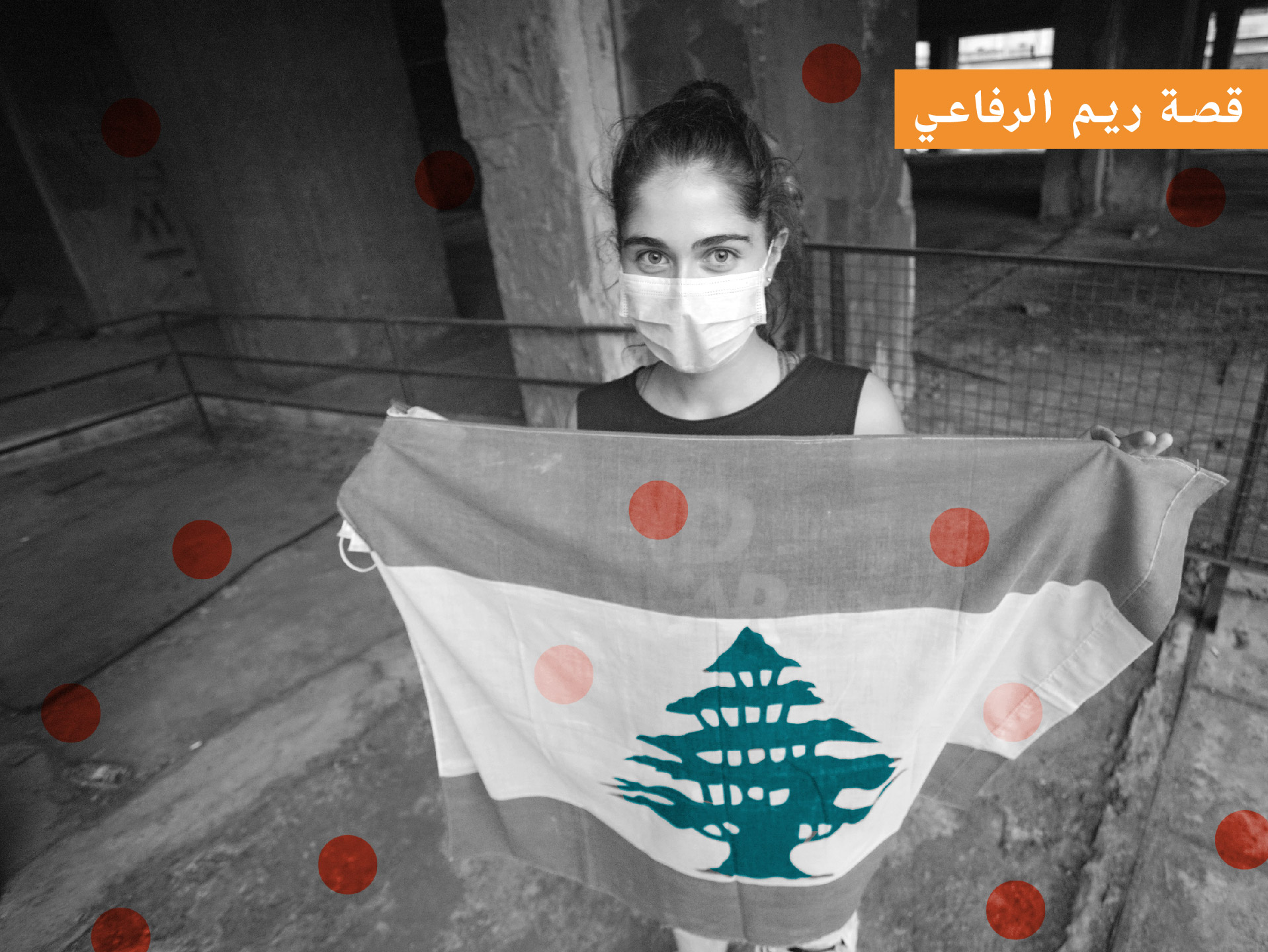
The driving force for Reem Al Rifaii’s participation in various protests across Lebanese regions has always been tied to her principle of serving the community; “having volunteered with the Red Cross in my hometown Tripoli, I witnessed a multitude of the worst effects of the state’s injustice, inflicted on the most vulnerable people. I think these injustices are what push me to resist.” Due to her family’s venture in Lebanese politics, Reem’s upbringing was always intertwined with politics and protests.
On the first day of protest after the horrible Beirut port explosion, August 6th, 2020, she was present in downtown Beirut near one of the blocked entrances leading to Nejmeh Square near the Beirut Souks entrance. Similar to most of the demonstrations she participated in, Reem did not know about any organizers but instead followed specific people she knew to places of demonstration. As she describes it, this specific protest included the largest amount of blatant and violent human rights violations she had ever seen. “It was around 7 pm and the sun had just set”, Reem explains “we were surrounded by security and military forces, endless clouds of teargas and smoke, and multiple soldiers and snipers on the roofs of buildings around us!” When a large group of demonstrators succeeded in breaching one of the gates, masses of tear gas rounds were fired by security forces at the civilians in the square, including Reem. She explains how she suffered complications despite being dressed in proper equipment, “during all protests I was very well equipped with a mask, helmet, gloves, and other useful things. But the amount of tear gas canisters and the intensity of the smoke clouds took me out instantly.” She was rapidly losing her breath and her vision was highly impaired; “I was screaming out, I can’t see! Anyone help me? I can’t see!” Someone answered her call for help and assisted her in order to reach the seaside road to get away from the chaos. Reem immediately left the protest to go home and tend to the burning sensations she was experiencing all over her body, and the extreme mental strain she had suffered.
The countless types of human rights violations that she acknowledges have been inflicted on her and other civilians, contain the right to social order and security, to expression of opinion and peaceful assembly, to safety and freedom from cruel treatment, and to human dignity. Reem asserts that no person should be exposed to tear gas, intimidation, or physical violence. When considering the psychological effect of these instances of human rights violations, Reem argues that the mental harm inflicted by the negligence of the ruling class mixed with the resulting crisis is far greater than that of the recent abuses of civilians’ rights. She concludes, “In terms of the mental and emotional effects caused by displays of violence by security personnel, it’s sad, but living in Lebanon – and specifically in Tripoli – has made me and many of us desensitized to similar things throughout the years.” Despite the dangers she acknowledged at the time, Reem continued to be an active demonstrator in a range of protests.
“many individuals who take part in different protests come from traditional and narrow-minded backgrounds. Many of them are sexist and homophobic, which endangers women and people from the LGBT community.”
During the Lebanese uprising’s New Year’s eve celebration in and around Martyr’s Square on the last day of 2019, she was flagrantly and inappropriately groped in the square by an odious civilian present among the people. “It was a total violation of my body and security! When I turned around to scream out and confront him, he had already taken off running into the crowd and disappeared” she communicates, adding that she never found out about his identity. Other than potential violations by members of the police and army, what mainly alarms Reem is the threat of harassment against women and queer individuals by fellow protestors; “many individuals who take part in different protests come from traditional and narrow-minded backgrounds. Many of them are sexist and homophobic, which endangers women and people from the LGBT community.”
The fact that she is a woman is one of the reasons why throughout most of her life ahead of the Lebanese October uprising, she had never felt a sense of safety around security forces, nor generally within the streets of Lebanon. Reem conveys her belief that there is an illusion about the spaces of protest being safe; “the safe space we wished the Lebanese uprising would resemble was never as inclusive or as safe as we thought, which is why demonstrations are dangerous settings specifically for women and members of the LGBT community.”
Although Reem encountered several violations of her innate human rights and witnessed countless acts of terror against other civilians, she continues to be enthusiastic about bringing forth change for the Lebanon she dreams of through protest; she describes the country she has her heart set on, “a secular Lebanon where I can dream of an actual future for myself, where my human and civil rights are respected.”