


“We have gained nothing from the revolution except freedom of expression.”
“We have gained nothing from the revolution except freedom of expression.” This statement is often repeated by public actors in Tunisia, implicitly highlighting the weak economic and social achievements of post-revolution governments compared to the gain of freedom of expression and demonstration, which protesters secured during the winter of 2010-2011. However, since the constitutional coup in July 2021 and President Kais Saied’s consolidation of all powers, Tunisia has entered a new phase. This phase has ended the decade-long oscillation between the revolutionary path and the democratic transition, as described by Monir El-Saidani, a sociology professor at the University of Tunis.
This new phase in Tunisia is marked by an unprecedented gray area in the Arab world. While it breaks away from the democratic transition framework and its institutions, it is different from autocratic regimes like that of Ben Ali or neighboring military regimes. In stark contrast to these models, the new era promises a grassroots, direct democracy that champions the spirit of the revolution and its demands for social justice and regional development, distancing itself from representative democracy associated with corruption and elitism.
However, this utopian project conceals an authoritarian tendency, as evidenced by President Kais Saied’s monopolization of political action through the dissolution or marginalization of constitutional bodies and democratic institutions, coupled with weak public engagement with the alternative institutions he proposes. Consequently, the regime of July 25 appears closer to reclaiming a model of patriarchal leadership and individual rule rather than establishing a new system that shifts power from the central to the local level, as it professes.
This regression to a presidential system is met with popular approval due to the failure of democratic transition elites to convince Tunisians of the efficacy of parliamentary democracy, particularly the possibility of combining “bread” and freedom. This poses unprecedented challenges to social forces, activists, social movements, and civil and political entities that continue to uphold the project and gains of the Revolution of Freedom and Dignity. Among the most crucial of these gains are freedom of expression and the right to peaceful assembly as essential dynamics for political action and change.
The Stakes of Freedom of Assembly and the Right to Peaceful Protest in Tunisia After July 25, 2021
Since July 25, 2021, there has been a notable decline in protest mobilization and demands, as indicated by the latest reports from the Tunisian Forum for Economic and Social Rights. This unprecedented context and its complex causes still require in-depth study. Some reasons include a waning belief in the efficacy of protests as a means for change and the President’s adoption of the rhetoric of social movements. This shift in political discourse has created a general sense of anticipation and expectation for the outcomes of his political project. Additionally, President Saied has successfully diverted attention from the government’s responsibility for the economic and social crisis by blaming hoarders, conspirators, and political opponents.
This quantitative decline raises questions about the future relationship between society and the state and the continuity of street movements and collective actions in holding power accountable and resisting possible deviations. However, a qualitative analysis reveals that while there is a decline in interest in “political politicking,” there is a significant increase in mobilization around social and environmental issues. Reports from the Tunisian Social Observatory highlight movements demanding a healthy environment and the right to water in various regions of the country and the 18/18 Movement in Zarzis, opposing European migration policies responsible for migrant deaths in the Mediterranean.
Recently, there has been a unique experience with the formation of a broad civil front in solidarity with sub-Saharan African migrants, which emerged in February 2023 to counter the racist campaign incited by the President’s inflammatory speech. These movements reflect the continued and accumulated knowledge and political experience of social movements in Tunisia. In a context where traditional politics appear to be dying, and the role of traditional intermediaries such as parties and unions is diminishing, it is crucial to value and build on these experiences. They serve as models for sustained citizen engagement in public affairs, which can protect the public space from regressing.
The Shrinking Space for Freedoms and Collective Action and the Rise of an Anti-Civil Society Narrative
The political changes following July 25, 2021, present a range of challenges to the freedom of protest and peaceful assembly, some new and some recurring. This populist phase has created a climate hostile to elites and intermediary bodies and placed civil society under popular and official scrutiny with legal and political dimensions. One of the most significant issues is the new government project to amend Decree 88 of 2011, which regulates the work of associations. Many civil society organizations consider this step a move towards authoritarianism, undermining the role of associations and threatening the right to organize.
Additionally, Decree 54, issued in September 2022, has been described by the Tunisian Association for the Defense of Individual Liberties as a sword hanging over the heads of opponents. Article 24 of this decree imposes a five-year prison sentence and a fine of 50,000 dinars on anyone who publishes news or statements containing personal data or attributes false information to others with the intention of defaming or tarnishing their reputation. Thus, it has shifted from its stated intent of combating cybercrimes to a repressive law used to prosecute activists, bloggers, and journalists critical of the government. Despite repeated calls from various sectors of society for the immediate withdrawal of this law, its victims remain in the courts. Some are public figures whose cases have garnered attention and solidarity, while others are ordinary citizens with little more than a Facebook account.
The Rise of Hate Speech Against Activists and Civil Society Organizations
The level of discourse has seen an increase in hate speech against activists and civil society organizations, accusing them of receiving dubious funds to serve political agendas or being foreign agents. This narrative has been employed by various ruling regimes post-revolution to discredit civil society and curb its role as a force for pressure and accountability. However, it has taken a more dangerous turn after July 25, as this rhetoric now fits into a broader narrative that views all intermediary bodies—parties, unions, and associations—as part of the so-called “black decade.” This term refers to the decade of democratic transition, which is stigmatized as chaotic and blamed for the current economic crisis.
The counter-revolutionary forces and supporters of President Kais Saied, along with hostile media and online voices, have contributed to this narrative. They have exploited public anger towards Islamists and the political system of the democratic transition to lump all active forces into one category of “corrupt elites benefiting from democracy,” in contrast to “the people.” Protests and strikes are blamed for harming the economic interests of the populace by weakening the state and degrading its services.
Social and protest movements have not been spared from this, as there have been calls to militarize production sites and rhetoric targeting protesters, accusing them of obstructing the “correction course” led by the president. This creates new challenges for activists. The legal and political climate hostile to collective action and the authoritarian direction of the July 25 regime has severe implications for the freedom and safety of activists. Some have reduced their public appearances or resorted to self-censorship. For example, activists in migration and migrant rights have faced defamation and harassment on social media, led by the Tunisian Nationalist Party. This racist right-wing organization has smeared activists, accusing them of serving foreign interests to settle African migrants in Tunisia, inciting violence against them, and threatening their physical safety, all while the authorities remain silent.
Moreover, the July 25 regime appears unenthusiastic about the Tunisian feminist movement and the gains it made post-revolution, such as the principle of gender parity in elected councils. The abolition of this principle in the new electoral law has diminished women’s representation in parliament and local councils, affecting the ability of activists and feminist organizations to access these institutions and weakening their influence.
Repressive Legacy and Renewed Challenges
A significant part of the challenges to the freedom of protest and peaceful assembly in Tunisia stems from a repressive legal system and political practices that predate President Kais Saied’s era. Various regimes after the revolution have sought to exploit and adapt the legacy of repressive laws from the authoritarian period to target their opponents and criminalize social movements that oppose them. The failure to abolish these laws and completely break with the prevailing security mentality in the state’s approach to protests is one of the major shortcomings of the forces of change in the decade following the revolution.
The state of emergency has been repeatedly extended, and elected parliaments have failed to amend repressive and liberty-depriving laws or adapt the Penal Code to align with the 2014 Constitution. These outdated laws remain tools for suppressing movements and free voices. The most recent victim is activist Rachad Tomboura, who was sentenced to two years in prison last February for a graffiti drawing, charged with “committing an obscene act against the President of the Republic.” This law dates back to the Beys era, specifically to the 1913 issuance of the Penal Code, which was later amended by Habib Bourguiba, the first President of the Republic, to fit the new status of the highest authority figure.
The heavy legacy of this code is also evident in Article 125, which charges “insulting a public officer” and is used by security personnel to prosecute activists and protesters under the pretext of assaulting them while performing their duties, serving as a tool for intimidation and impunity. Human Rights Watch has called on the Tunisian parliament to repeal this article since 2017 due to its contradiction with Tunisia’s human rights commitments and the repeated instances of systematic targeting of activists and whistleblowers for police abuses under this law.
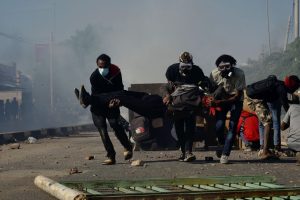
In addition to this arsenal of laws that conflict with democratic principles, human rights organizations have documented continued repressive practices and intimidation methods against protesters and field activists in the regions. These include harassment and summonses for questioning due to organizing or participating in protests.
Street Protests and Resilience Amidst Restrictions
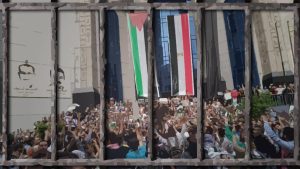
Despite the numerous restrictions on freedoms and the general climate of caution that prompts many activists to be wary, the streets of Tunisia remain a vibrant arena for struggle and expression, reflecting the steadfast commitment to the gains of the revolution and citizen participation. Recently, the Palestinian cause has revitalized the streets across various regions through marches supporting resistance and field activities of the boycott campaign against companies backing the Zionist entity. The national march on March 8, marking International Women’s Day, exemplified the intersection of struggles, bringing together feminist, queer, and labor movements, as well as various political components, under the banners of Palestine and anti-colonialism.