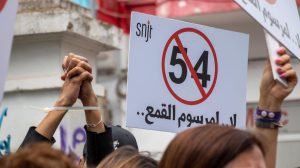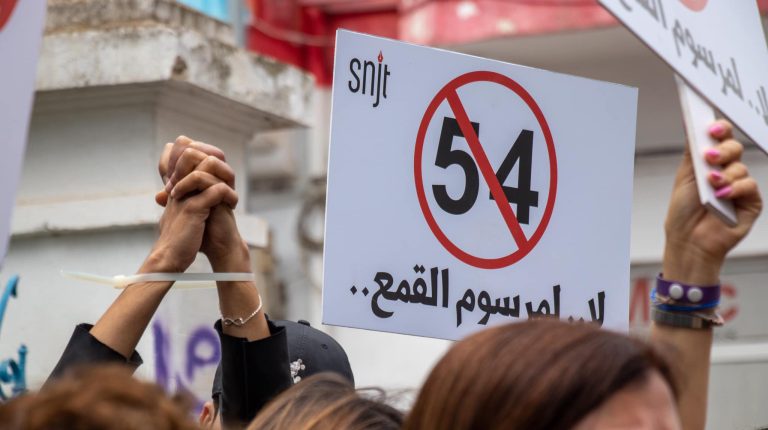

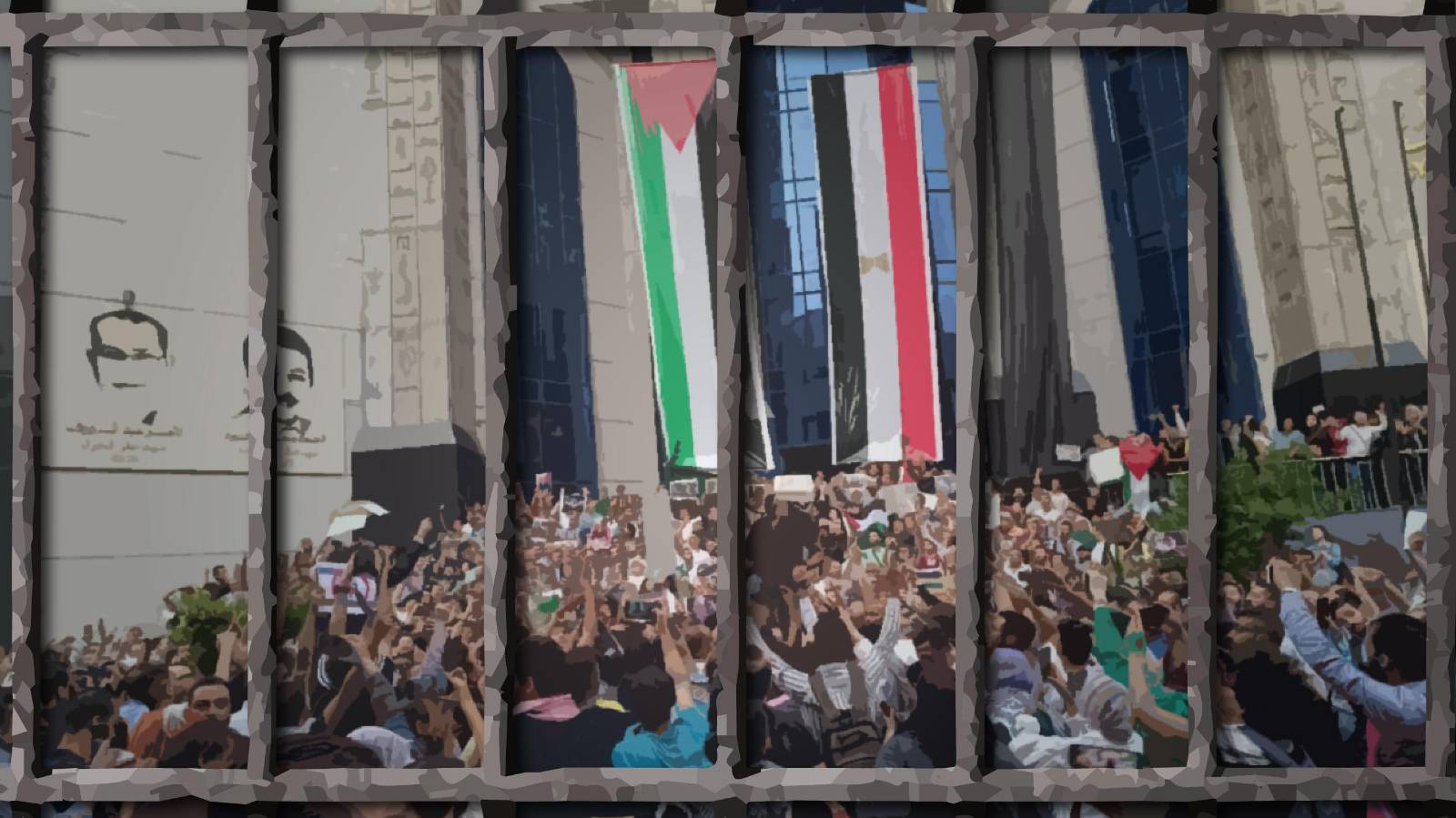
This month, in the early hours of April 4th, Egypt’s National Security forces abducted 14 Egyptian citizens who had just joined a pro-Palestine protest the evening before. The 14 detainees were promptly presented before the Supreme State Security Prosecution, Mada Masr reported, where they faced charges of joining a terrorist organization and publishing false news. Two days later, following pleas of state-sanctioned opposition, the country’s political might trumped the prosecution decision and ordered the 14 protesters released.
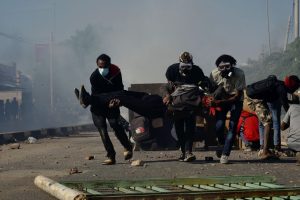
In Egypt, protests have been subject to nationwide heavy-handed security control for over a decade, and pro-Palestine protests are no exception. In October, over a hundred citizens were arrested and met with terrorism charges after they marched for Gaza, of which at least 90 citizens, including two children, are still detained behind bars, according to a statement from The Egyptian Initiative for Personal Rights.
The April’s wave of arrests came one day following the inauguration of President Abdel Fattah al-Sisi into his third presidential term and only two weeks after the European Union injected billions of dollars into the regime’s pocket amid fears from critics that the bloc, as Human Rights Watch put it, is “rewarding authoritarianism.”
The truth is, there couldn’t be a more accurate depiction of Sisi’s politics nor of the unconditional support his ruling still harvests from international powers. If anything, the freedoms to protest and to peaceful assembly are hampered in today’s Egypt due to the unforeseeable challenge or accountability to Sisi’s autocracy.
Egypt’s Sisi: A Textbook Authoritarianism
Following the 2011 uprising, Egypt’s public sphere saw some of its liveliest days ever. New political movements, coalitions, and parties emerged; numerous protests, labor strikes, and various forms of long-silenced peaceful street politics resurfaced. Nevertheless, Egyptians couldn’t embrace such days for long enough.
In June 2013, Egypt’s then-Field Marshal Abdel Fattah al-Sisi orchestrated a military coup and assumed presidential power only a year later. Since then, the country’s civic space has been ruled with an unshaken iron fist. Egyptians have been living through brutal forms of authoritarianism, i.e., mass arrests, extralegal detentions, forced disappearances, silencing of all forms of critical media, and turning off any safe outlet for citizens to assemble or express dissent.
“Since 2013, Sisi’s governments have been responsible for massacring protesters and jailing and torturing thousands of perceived critics and opponents – often holding them in protracted pre-trial detention or sentencing them in grossly unfair trials. Independent media and civil society have been stifled, and the judiciary is an obedient arm of government repression. The ruling military has expanded its powers over civilian life,” said Human Rights Watch in a 2024 report.
And despite the brutal crackdown on local rights organizations, a few are still determined to voice their critical stand.
“On Egyptian streets that once echoed with protest, there are now literally zero demonstrations a year,” said Hossam Bahgat, director of The Egyptian Initiative for Personal Rights, to AFP last June.
“This is the worst decade for human rights in the country’s modern history.”
Exceptional Legal Tracks and Traps
Since 2013, the governments of Abdel Farttah al-Sisi have mobilized all legislative forces to restrain the freedoms of expression, of organizing and of protest, through a number of exceptional legal instruments, including the infamous 2015 Counterterrorism Law, which paved the way for Sisi’s security apparatus to imprison and abduct tens of thousands of citizens in the most arbitrary fashions, even to extrajudicially shoot and kill citizens in the name of combating terrorism.
On the list of exceptional legal and legislative instruments deployed to restrain basic freedoms of expression and assembly is The Terrorist Entities Law (law 8 of 2015), which regulates the listing of designated terrorists and terrorist entities, while in reality it has been used to target and include activists and independent critical voices on designated terrorist lists based solely on unconfirmed police investigations.
The arsenal of repressive laws deployed by Sisi’s administration also include Law 136 of 2014 on the security of public and vital facilities, which expands the authority of the military jurisdiction over civilians.
Meanwhile, the independence of the Egyptian judiciary has been radically eroded by Law 13 of 2017, which gives the president the power to select and appoint the heads of judicial authorities, including the Cassation Court and State Council, and by the 2019 constitutional amendments, which granted the president the authority to appoint the head of the Supreme Judicial Council.
And despite all these legal adaptations of intensified repressions and freedom restrictions, Sisi’s security state stands tempted to abuse its very own extreme laws.
For instance, according to the Counterterrorism law — the most widely used tool to justify violations against individuals and groups in the last decade — a “terrorist group” is defined as such when it consists of “at least three people.” So if it takes three people to form a terrorist group, how does the security apparatus manage to enforce this law against single individuals? In the case of Egyptian researcher Ahmed Samir Santawy, as it is in all other similar cases, this apparently was not an obstacle.
“When I was first abducted by the National Security Agency, I was interrogated alone,” said Santawy. “And when they filed a terrorism case against me, accusing me of belonging to a terrorist group, all they needed to do was add up the names of two other random individuals,” he explained.
“I never met the two other names in my case. In fact, they were not even arrested nor were they in Egypt. The security apparently looked up critical social media posts, and picked two random Egyptian profiles living abroad and joined them in my case.”
With those repressive legal instruments, and the unbounded manipulation of litigation rights, Abdel Fattah al-Sisi has turned the country into an open-air prison, given that in less than a decade he doubled up the country’s number of prisons, and imprisoned at least some 60,000 citizens. In 2024, the country was ranked by the World Justice Index 136 out of 142 countries in the Rule of Law Index.
Paranoia-driven Crackdown
The freedoms to protest and to join peaceful assembly are not merely a yearning for a nostalgic post-january revolution moment, they are rather widely argued as solid markers for a healthy state-society dynamic.
The space available for representations of civic engagement within a society, by granting the rights to protest and to the freedom of assembly, can be contested not only in the interest of society, but also for the ruling state. For, a state that is keen on preserving stability within society and for the stability of its power, must recognize legal and safe channels for peaceful assembly.
However, the counter-revolutionary politics of the Egyptian state have gone too obsessive with crackdown measures, using them so indiscriminately even against symbolic solidarity protests with regional causes such as the recent pro-Palestine demonstrations.
On March 8, dozens of Egyptian women took the streets of Cairo’s downtown in show of solidarity with Palestine, only to quickly be obstructed by security forces. “Who are you associated with?” an officer stopped the chants and shouted at the protesting women, “Who gathered you all here?”
“It’s not a coincidence that the officer repeatedly asked the women protesters in solidarity with Gaza: “Who are you associated with?” Lobna Darwish, one of the protesters, wrote on social media. “There’s a deep conviction within this regime that nothing would inspire people to express their stand unless they are associated with some group or are incited by someone. This mirrors their deep fear of any form of organization or assembly, and their narrow-minded world view.”
“And anyway .. what [association] did you leave [safe] for anyone to belong to?”
There must be a way out..
With the economic crisis clouding up more skies over the heads of the Egyptian people, with the latest currency devaluation and with the repercussions exasperating a day after another, the absence of safe channels for Egyptian citizens to freely express their opinion alerts an even more unstable horizon.
The international actors, who may be as complicit as Sisi’s own loyalists, must realize before it’s too late how flawed their investment is in Sisi’s power. The Egyptian people are struggling right now like never before under the current economic and political deadlock, and supporting the country’s dictator without exerting any pressure to loosen the grip over the civic space, and to open up, before it’s too late, all channels for peaceful assembly and freedom of expression, will only result in all unpredictable, unwanted scenarios.